Evaluate the filter. Do not fork free IP.
This page explains GSRF Practical identity at the safety-cage level. Full evaluation runs through Axiom Workbench (universal evidence factory) or licensed packages such as gsrf-bench. Evaluation only—not a production license grant. No free copy-pasteable proprietary schedule.
Product: info@boonmind.io · Request Audit Pack
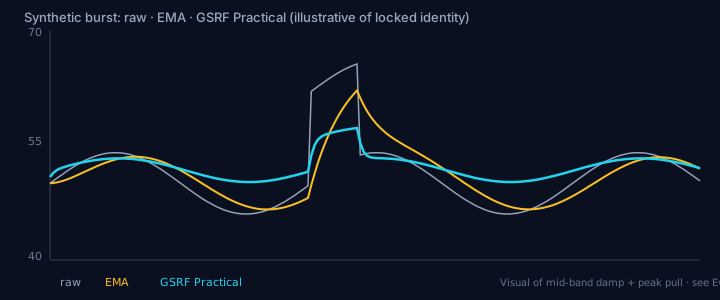
What it looks like (static)
Raw vs EMA vs GSRF on a synthetic mid-band + spike sample—illustrates ring damp and peak pull. Not a free-form playground; locked metrics live on Evidence.
Evaluation path (no free implementation drop)
GSRF Practical is a log-space soft thermostat: a restoring spring k_return toward a declared normal x*, and a tanh-bounded observation pull (symbol w_obs). Those symbols describe identity and the public safety cage — not a free parameter schedule.
Conceptual steps (non-executable)
- Declare normal x* from a calm baseline (pre-declared setpoint).
- Map positive observations into log-space for relative, scale-stable control.
- Apply a bounded observation pull (tanh of log-space error) so spikes cannot dominate.
- Apply a restoring spring toward x* to damp mid-band ring and compress peaks.
- Map back to positive amplitude for the stabilized series.
Proprietary schedules, full state updates, and production presets are not published here.
Evaluate candidates against frozen baselines with cryptographic audit packs via
Axiom Workbench
(ai_computed_metrics: false).
Request a sealed evaluation gsrf-bench LICENSE-EVAL Request Audit Pack
What the output looks like
Static reference table from locked synthetic characterization (seed 20260426) — illustrative only; not a free re-run recipe:
| Metric | Raw Signal | GSRF Practical | Improvement |
|---|---|---|---|
| Oscillation (std high-pass) | 2.162 | 0.685 | ~ −68.0% |
| Peak Excursion | 15.5 | 9.6 | ~ −38.0% |
| Tracking (MAD) | 0.000 | 2.326 | (worse—by design) |
Trade-off is structural: oscillation/peak control can cost tracking MAD vs raw. Not a universal guarantee.
Static reference for the synthetic sample only — not a universal performance guarantee. Full locked packs: Evidence.
What to look for
- Spike peaks pulled toward the normal (x*)
- Mid-band ring quieter than raw (and often vs a light EMA)
- MAD-to-raw often worse than EMA — expected
- After a permanent level shift, freeze vs adaptive x* (see evidence §3)
What the trial unlocks
- Validated balanced / conservative / fast presets
- Axiom Workbench evaluation path (audit packs)
- Claim ladder + NDA packs when needed
- Commercial terms for Pro / Enterprise / QEC path
Still have 60 seconds?
Read the red lights before you productize anything.
Questions people actually ask
How do I evaluate GSRF?
Use Axiom Workbench for locked audit packs, or licensed gsrf-bench under LICENSE-EVAL. This page does not ship free proprietary code.
Does this page grant production rights?
No. Commercial license required for production. Pricing →
Want Axiom Workbench?
Request a sealed evaluation · Request Audit Pack · Product narrative
What is Axiom Workbench?
Universal evidence factory: method + data → allowlisted run → locked pack (no AI-invented metrics). Pre-declared setpoints · frozen evaluators · deterministic governors · unvarnished verdicts. Details: workbench.html#service.