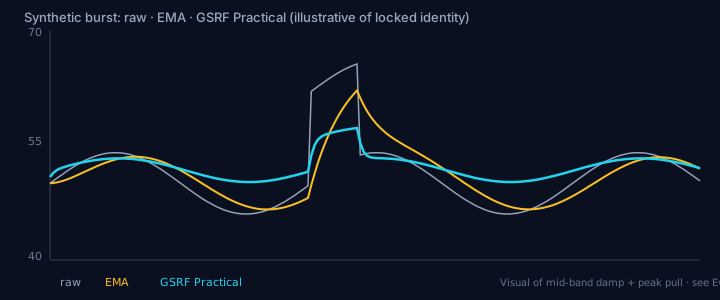
~70%
Kills mid-band ring
Spectral power reduction in the sweet band (period ≈ 50–120 samples; often minutes on 1‑min industrial traces) vs best EMA on locked packs.
phase6.2 · download pack · section
Most filters either chase the noise or smear the truth. ZO does neither. It pulls mid-band ring down and compresses peaks toward a declared normal — so detectors, controllers, and models see a calmer input before the expensive stage.
Locked packs. Published failure modes. No slide-deck metrics. Pre-stage hygiene for industrial / SCADA-style and command–measure loops — not a general tracker, not a delay-tolerant command smoother, not a universal industrial-PID composite champion.
Your CSV beats demos · keep the receipt · license when the job matches · Pricing · info@boonmind.io
Spectral power reduction in the sweet band (period ≈ 50–120 samples; often minutes on 1‑min industrial traces) vs best EMA on locked packs.
Mean peak-deviation advantage vs best EMA; 49 / 52 dataset wins across characterization families.
Frozen \(x^*\) stuck after permanent jumps; adaptive \(x^*\) tracks 50 → 70 → 40 without abandoning the spring.
Operating conditions matter. These are jobs the filter is built for — not a claim of universal victory.
Soft-thermostat behaviour in the sweet band already locked in evidence (~35% osc / ~70% spectral vs best EMA on pack surfaces). Detectors and controllers see less chatter before the expensive stage.
See ring-kill evidence →Peak-deviation advantages on locked packs (~38% mean; 49/52 wins across characterization families). Spikes are pulled toward the normal you declare — not magically erased.
View peak-compression traces →Frozen \(x^*\) stuck after permanent jumps; adaptive \(x^*\) tracks regime changes without abandoning the spring — pre-stage hygiene, not a controller claim.
Read adaptation case →Industrial / SCADA-style and robot true cmd+meas surfaces stay on the Evidence hub (including robot true-cmd continuous wear 298/298 pack links).
Industrial actuators and controllers often suffer from mid-band resonance and overshoot—oscillations that waste energy, wear down hardware, and confuse downstream logic. Traditional smoothing filters introduce delay or phase distortion, while clipping loses information about the underlying process.
Zero Overshoot operates as a deterministic soft-thermostat. It applies controlled braking to suppress overshoot without the usual lag trade of heavy smoothing, compresses peaks without clipping, and tracks signal statistics so the thermostat can follow real regime shifts. The transformation is fixed: given the same input and freeze, you get the same output. Runs are auditable and reproducible.
On the commercial and audit path, Zero Overshoot is backed by sealed evidence packs: input and output fingerprints, parameter freeze, metric tables, and a SHA-256 ledger where that path applies. You do not have to trust a slogan—you can open the pack. Public locked packs and limits live on the Evidence hub; eval and CLI paths state what they include.
Zero Overshoot is built for dynamic overshoot and mid-band ring on the jobs we publish. It is not a mechanical cure for stiction, sensor drift, or wear in the hardware sense. On stiction-heavy traces we report oscillation behaviour under locked packs—not a universal industrial win. Outside the surfaces we publish, we do not claim an edge. We publish losses and red lights alongside wins. See Evidence and When GSRF lost.
Need to compare Zero Overshoot against EMA, SMA, or another method under one frozen claim? Axiom is a controlled evaluation lab: sealed multi-method comparison, not a public unlimited workbench. Request a sealed evaluation.
Your CSV beats our 52 datasets for a purchase decision. gsrf-bench is the free credibility engine — run GSRF Practical vs EMA locally (osc31 · peak_dev · MAD · spectral).
Loudest path:
install eval/ → gsrf-bench --input your.csv --normal <x*> → read the metrics.
No sales call. Non-production LICENSE-EVAL.
Evaluation only. Production needs a license after you like your own numbers. Pricing · email only after self-serve: info@boonmind.io
Existing paths only — open evidence, run gsrf-bench, or request an audit pack.
Local offline characterization engine: frozen evaluators, pre-declared rules, multi-method overlays, synthetic + adversarial + DAMADICS real-plant packs. Marketing only climbs the claim ladder.
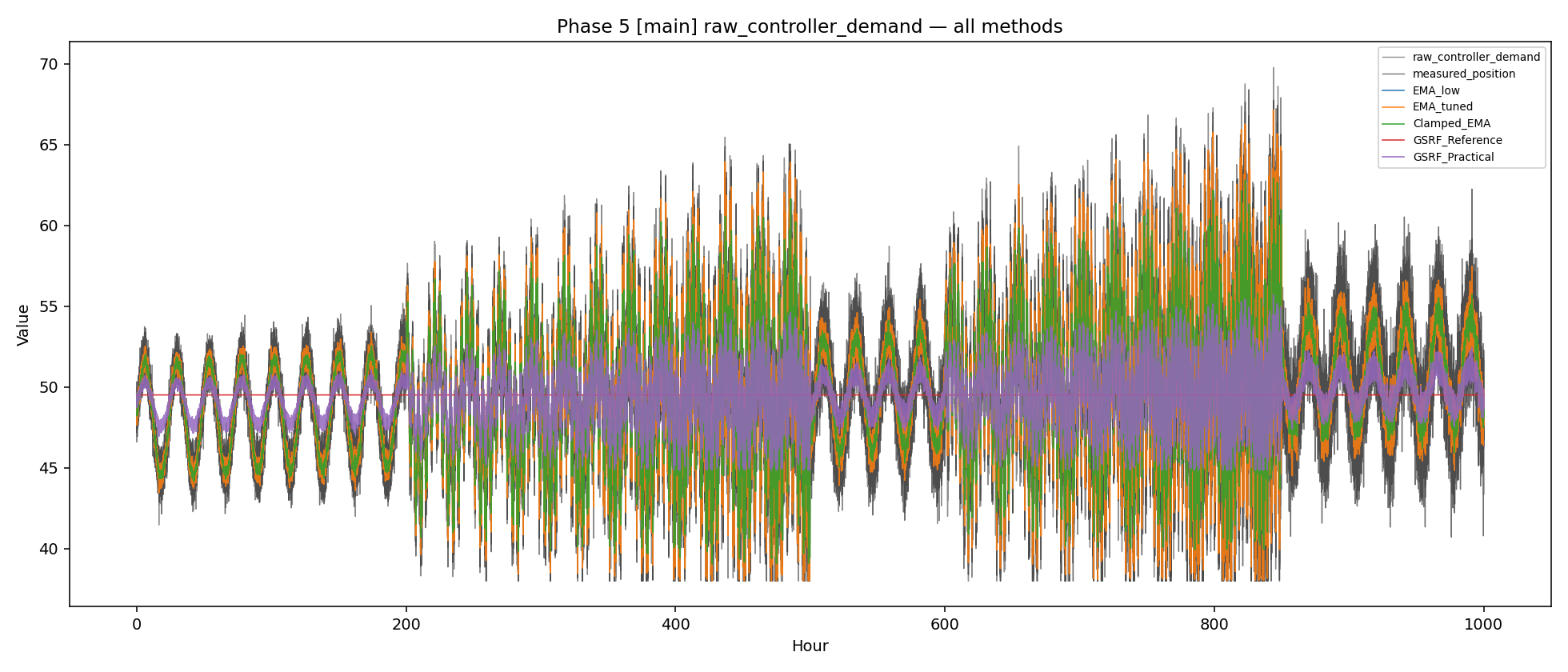
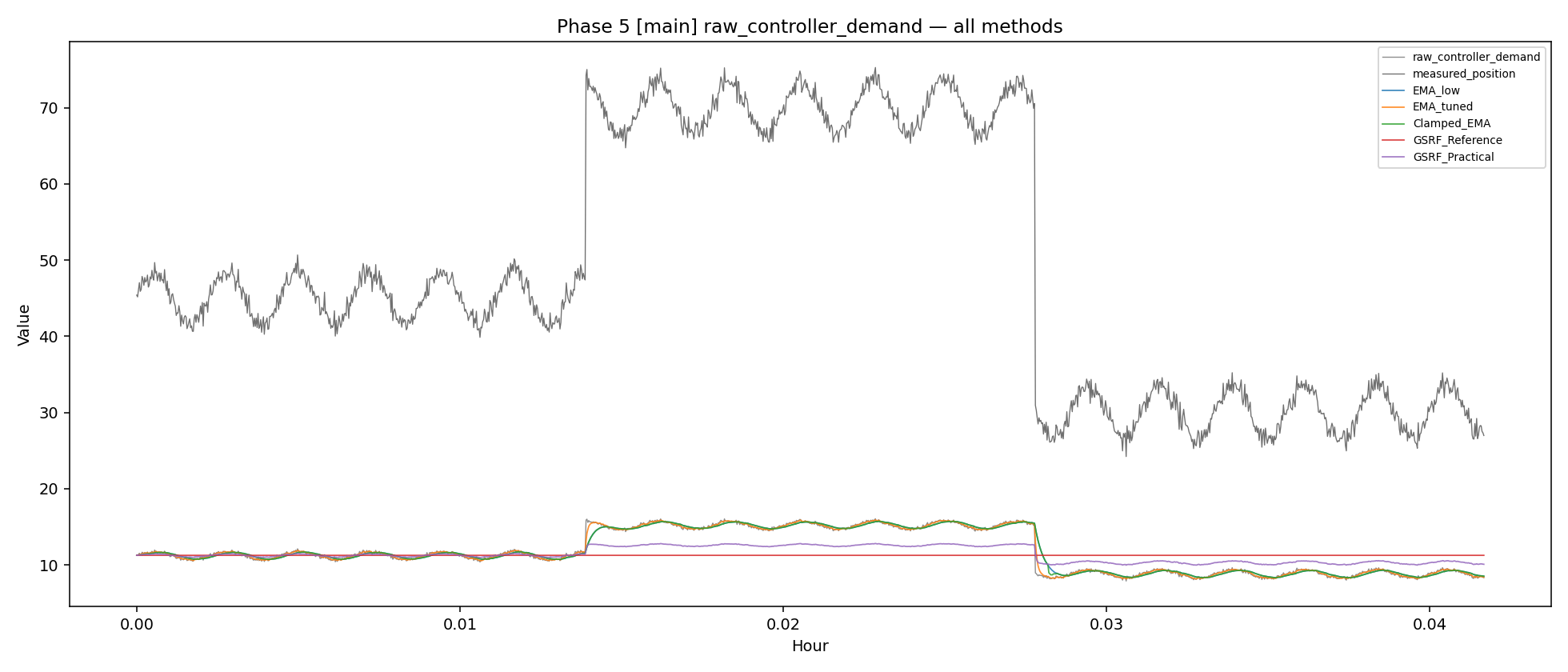
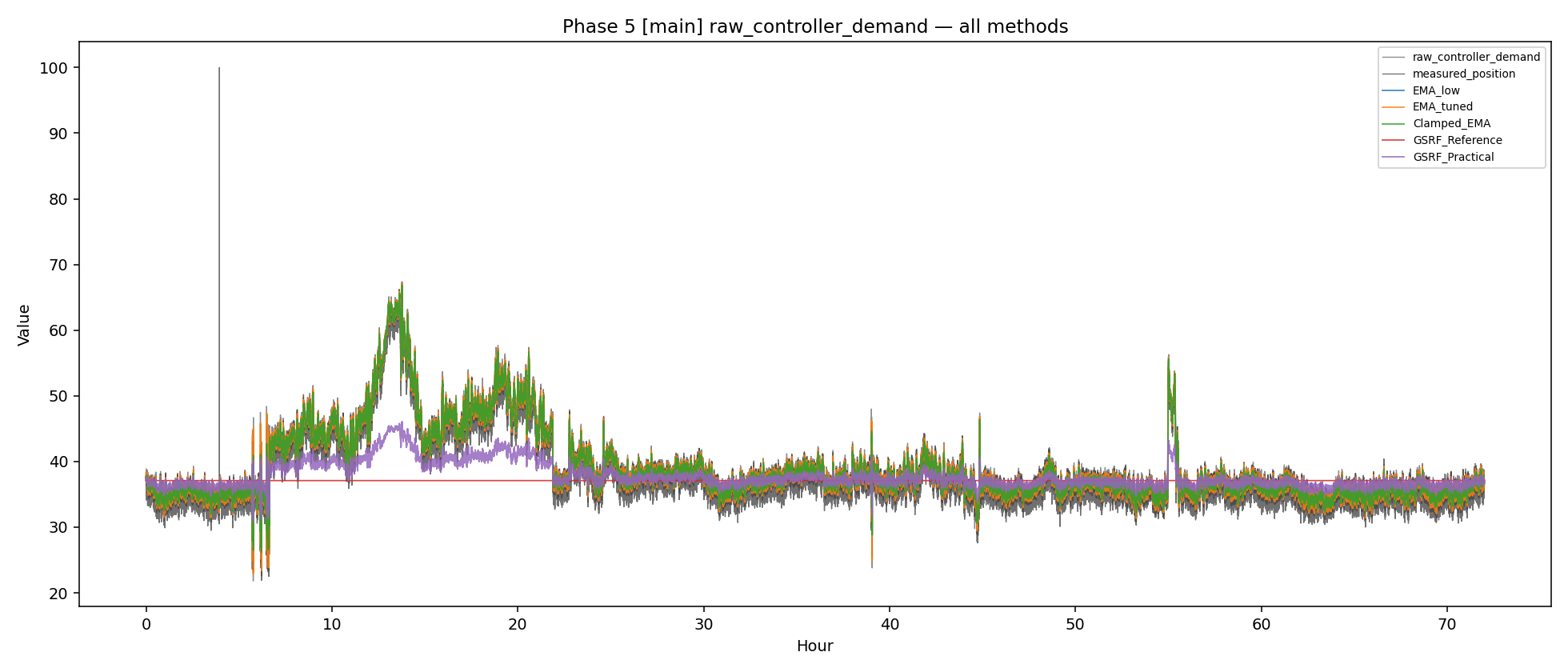
Identity, frequency, adaptive x*, safety cage, industrial packs with charts.
Characterization system, gallery, claim ladder.
Long-form notes from locked packs.
PDFs + technical library index.
Commercial flagship. Kill mid-band ring and compress peaks on valve/SCADA and true cmd+meas robot surfaces — with packs. Pre-stage filter, not a motion controller.
GSRF vs EMA vs Kalman decision table.
Eval / Pro / Enterprise / QEC path.
Long-tail: pre-model sensor hygiene for industrial AI.
Robotics, control, integration, production checklist.
DAMADICS paper, eval package, PDFs.
Safety cage detail: Evidence §4 · Losses: When GSRF lost · Quantum: separate ladder
Short-tail answers. Long-tail deep dives live in Research and the full FAQ.
A deterministic log-space soft thermostat that damps mid-band oscillation and compresses peaks toward a declared normal so detectors and controllers see calmer inputs — with locked packs and published limits. Identity →
No. Often wins mid-band osc and peaks on locked packs; loses tracking MAD, delayed command paths, fixed-FA residual. Compare →
Not universally. Surface-labeled results only — stiction-class osc and provisional slow-track wear on independent synthetics; plant DAMADICS hardness published; robot true-cmd continuous wear holds (ABB/UR/Franka) with osc/rate labeled. Pre-stage filter, not a controller. Actuators flagship →
Open the packs, Python snippet, or local gsrf-bench on a CSV. Evaluation only.
MAD tracking, multi-minute delay as command smoother, fixed-FA residual alarms. When GSRF lost → · Wrong tool for multi-method edges? Request a sealed evaluation
No. Commercial license required for production. Pricing →