Locked evidence. Documented limits.
Every number below comes from the GSRF Audit Workbench characterization packs— not slideware. Competitors sell confidence. We sell receipts.
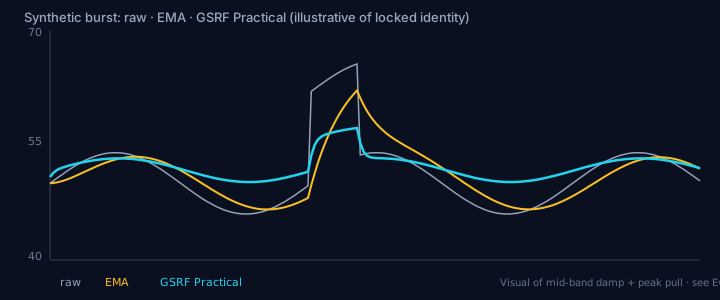
All four sections are on this page—scroll or jump. Nothing is hidden behind tabs.
Safety cage — at a glance
| Status | Topic | Locked finding |
|---|---|---|
| Green | Mid-band oscillation | ~+35% osc31 vs best EMA; ~−70% sweet-band spectral power (phase6.2 full series) |
| Green | Peak compression | ~38% mean peak-dev advantage; 49/52 dataset wins — download pack |
| Green | Adaptive x* | Regime jumps 50→70→40: frozen ~9.7 error → adaptive ~1.5 |
| Red | Feedback delay | MAD to measured vs EMA: +59% / +97% / +106% at τ=3 / 6 / 10 min |
| Red | Fixed-FA detection | Residual recall ~0.44 GSRF vs ~0.83 EMA at matched FA |
| Red | Tracking MAD | 0/52 wins vs best EMA — spring costs tracking by design |
Full narrative, charts, and sources: sections 1–5 below. Industrial actuator battery → · Green/red detail →
Download receipts (not a curtain)
Open the ledgers behind headline numbers. Partial public packs from frozen Workbench runs. Still better: gsrf-bench on your CSV (~10 min).
- 49/52 peak compression — ZIP · CSV
- 298/298 robot true-cmd wear — ZIP · fleet ledger CSV
- Mid-band osc / spectral — ZIP
- All packs index →
1 — The identity
GSRF is not “EMA with better marketing.” It is a soft-servo to a declared normal.
state lives in log-space; output = exp(x)
Step response (the intentional trade-off)
Step from 50 → 65 with x* frozen at the pre-step normal. Plot from locked workbench CSV:
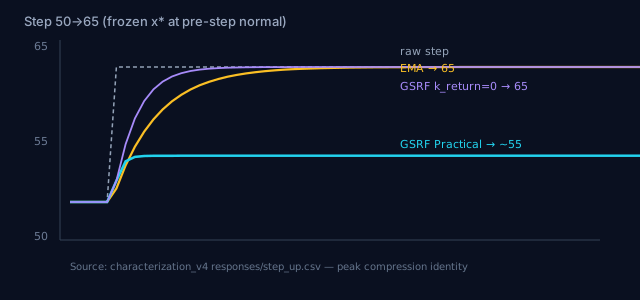
| Method | Settles near | Meaning |
|---|---|---|
| EMA | 65 | Tracks the new level |
| GSRF k_return = 0 | 65 | Spring off → tracker-like |
| GSRF Practical (balanced) | ~55 | Halfway home — spring vs observation pull |
| GSRF Reference | 50 | Open attractor twin (not a live tracker) |
That halfway settle is peak compression. It is also why MAD-to-raw loses. If you need full settle after a permanent jump, move x* (see section 3)—don’t pretend balanced GSRF is EMA.
Source: workbench characterization v4 · responses/step_up
2 — Frequency sweep & the sweet spot
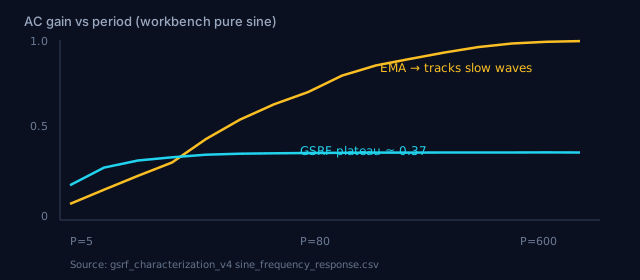
Headline: GSRF is tuned to clamp amplitude toward normal and kill mid-band ring—not to track slow waves.
Gain plateau (pure sine, workbench)
RMS AC gain vs period. EMA → 1.0 on slow waves. GSRF plateaus ~0.37. Points from locked CSV:
Oscillation metric + spectral power
| Result | Number | Notes |
|---|---|---|
| osc31 vs best EMA | ~+35% | phase6.2 · 3 seeds · full series |
| Sweet-band spectral kill | ~−70% | Same packs · not a rolling-31-only artifact |
| Frequency-sweep sweet spot | P ≈ 50–120 | Peak ~+51% osc adv at P=80; loses at very fast (P=20) and very slow (P=400–600) on osc31 |
Sources: characterization v4 · probes v5 FULL PSD · excellence hunt v2
3 — Adaptive x* (the fix for permanent jumps)
Headline: We fixed the “stuck after step” failure mode for multi-regime plants—by moving the thermostat, not by lying about the spring.
Synthetic permanent shifts 50 → 70 → 40 with mid-band oscillation. Mean |error| vs true regime base on regimes B+C:
| Method | Mean abs mean-error (B+C) |
|---|---|
| GSRF frozen prefix x* | ~9.7 (stuck on old normal) |
| GSRF fixed full-series x* | ~9.7 |
| GSRF adaptive (window 200) | ~1.5 |
| EMA_low | ~0.5 (best pure tracker) |
In the original regime, adaptive GSRF still beat EMA on oscillation (osc31 ~0.50 vs ~0.78). On real data: adaptive helps multi-regime industrial/MBP-style traces; do not blindly adapt on flat SpO2.
Sources: probes v5 adaptive · realdata v6 VitalDB/phase5 matrix
4 — The safety cage
Feedback delay
MAD to delayed measured plant vs EMA:
- τ = 3 min: GSRF ~+59% worse
- τ = 6 min: ~+97% worse
- τ = 10 min: ~+106% worse
Do not use balanced GSRF as a delayed closed-loop command smoother.
Fixed-FA alarm detection
At matched false-alarm rate on synthetic excursions (residual mode):
- GSRF recall ~0.44
- EMA recall ~0.83
Peak compression and higher normal residual force a higher threshold when FA is matched. Use a detector for alarms; use GSRF to calm.
Use freely (within band)
These are the jobs GSRF is built for. Numbers are from locked workbench packs, not demos.
- Oscillation kill / mid-band spectral calming — osc31 ~+35% vs best EMA; sweet-band power ~−70% (phase6.2 full series, 3 seeds)
- Peak compression toward defined normal — ~38% mean peak-dev advantage; 49 / 52 wins across characterization families
- Adaptive x* when the plant’s normal truly moves — permanent jumps tracked without abandoning the spring (frozen ~9.7 → adaptive ~1.5 mean abs error)
- Pre-AI / pre-model signal hygiene — calm ring and spikes before expensive inference (not sold as a detector)
Frequency sweet spot: period ≈ 50–120 samples (peak osc adv ~+51% at P=80). Outside that band, re-check with your metric—very fast (P≈20) and very slow (P≈400–600) osc31 can favor EMA.
Sources: characterization v4 delay · probes v5 alarm & PSD · excellence hunt v2 · adaptive probe v5
5 — Industrial actuator batteries (synthetic, bounded)
oscillation_power with Workbench mid-band/spectral pack claims.
Full local lock: lab evidence under boundary battery + inspection note (not a public win pack).
Two packs (19 files total). Metrics from the Audit Workbench only — shaping score = wear + churn + rate-stress + osc31 vs best EMA (≥3/4 clear, 2/4 partial, 1/4 mixed, 0/4 loss).
Aggregate (honest)
| Pack | Type | Files | Clear | Partial | Mixed | Pure losses |
|---|---|---|---|---|---|---|
| Seven industrial actuators* | Synthetic SCADA-style | 7 | 5 | 1 | 1 | 0 |
| Adversarial Tier-1 | Synthetic (anti-complimentary) | 12 | 2 | 6 | 4 | 0 |
| Real / public first look† | DAMADICS plant + TE simulated | 6 | 0 | 2 | 0 | 4 |
*Turbine/RO remaps documented. †Early DAMADICS first look (3 actuators × 3 days) superseded by multi-day pack below. TE Mode-1 XMVs are simulated plant, not field actuators. Same frozen evaluator — real plant is harder.
What we claim / refuse
- On synthetic packs: regime-bounded shaping wins (7 clear / 7 partial / 5 mixed / 0 loss on 19 files)
- Adversarial pack included (only 2/12 clear) — not flattering-only
- On synthetic Phase 5 MAIN, wear+osc often both favor Practical vs best EMA (pack-dependent)
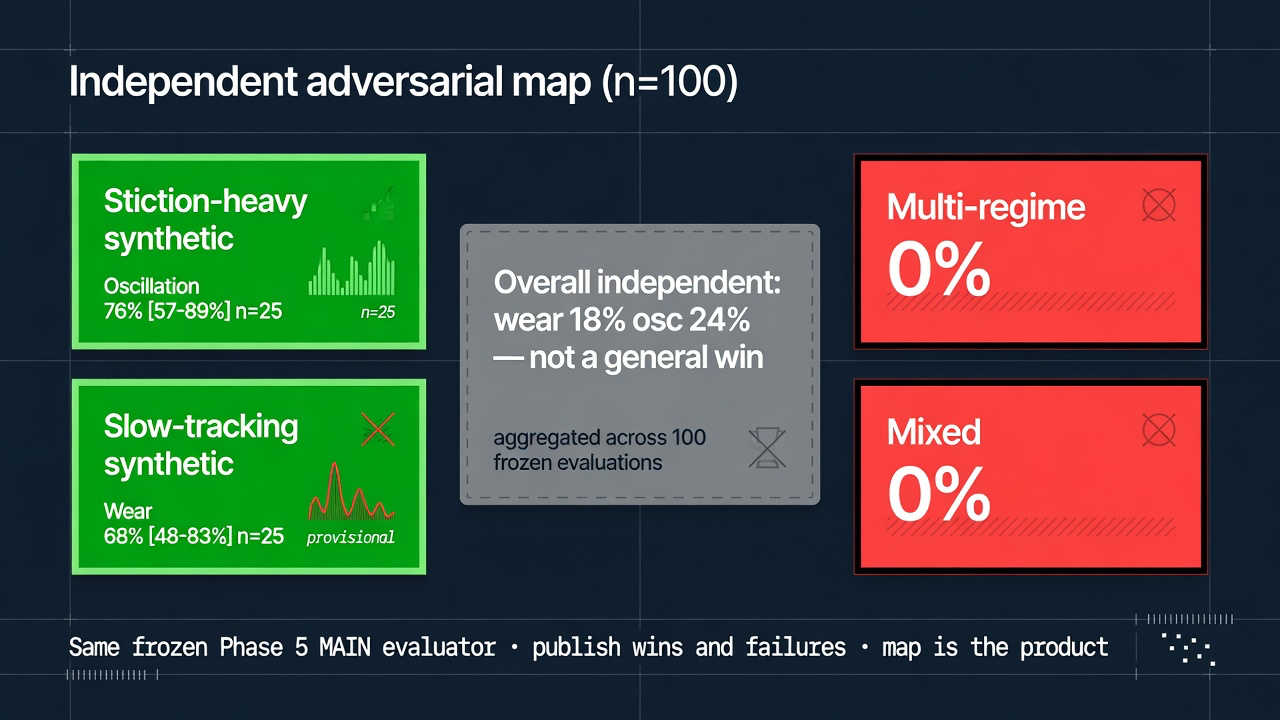
- Independent stiction stratum: osc win rate ~76% [57–89%], n=25 (labeled synthetic)
- Independent slow-tracking stratum: wear ~68% [48–83%], n=25 (provisional)
- On real DAMADICS multi-day: full day table — mostly composite loss; per-metric rates published
- Tracking MAD vs raw worse for Practical when it shapes — spring identity
- “GSRF wins industrial actuators” without qualifiers
- Treating synthetic 0-loss as real-plant proof
- Averaging synthetic + DAMADICS + TE into one fake win rate
- “88% wear wins on Lublin” or other inverted metrics not in DECISION_SUMMARY
- Universal “~95% wear on any adversarial synthetic” (generator-family only; independent overall ~18%)
- Kalman / commercial toolbox bake-off (not run here)
Real plant multi-day (DAMADICS Lublin)
CV → demand, X → measured. Early 3-day first look (2 partial / 1 loss) is superseded by multi-day.
Composite verdicts (per-day, 75 runs)
| Clear | Partial | Mixed | Loss |
|---|---|---|---|
| 1 | 6 | 8 | 60 |
Per-metric vs best EMA (same 75 days) — inversion check
When the composite looks bad, open the ledger. Lower is better for wear / osc / rate / MAD.
| Metric | GSRF better than best EMA |
|---|---|
| Wear (total travel) | 1/75 (1.3%) — GSRF usually higher travel (~1.8× mean) |
| Rate-stress | 14/75 (18.7%) |
| Oscillation | 8/75 (10.7%) |
| Churn | 0/75 |
| MAD tracking | 0/75 (spring cost) |
Domain pattern (honest): synthetic Phase 5 SCADA-style packs often show shaping (incl. wear) edges; multi-day Lublin is hard — composite mostly loss. Same frozen rule. No wear-champion claim on real plant.
Independent adversarial map (stratified, n=100)
| Domain (independent synthetic) | What GSRF does vs best EMA | Evidence |
|---|---|---|
| Stiction-heavy | Reduces oscillation | 76% [57–89%] Wilson 95% CI · n=25 |
| Slow-tracking | Reduces wear (provisional) | 68% [48–83%] · n=25 · CI low edge near 50% |
| Multi-regime (this pack) | No metric niche at 50% bar | 0% wear · 0% osc · n=25 |
| Mixed pathologies (this pack) | No metric niche at 50% bar | 0% wear · 0% osc · n=25 |
| Overall independent (100 files) | Does not win “general industrial synthetic” | Wear 18% [12–27%] · osc 24% [17–33%] · loss 62/100 |
Generator-family note: Earlier tier‑1 synthetic adversarial fleets can show high wear win rates within that family. Independent generation does not reproduce a universal ~95% wear claim — label family when quoting those packs.
True command+measured: the test that mattered
The EMA-proxy robot data was always marked as provisional. True command+measured is the real test — native controller (or teleop) demand vs independent measured, frozen Phase 5 MAIN vs best EMA.
Wear is not a proxy artifact. 298 continuous true-command samples across three platforms — 0 losses. We’re ready to run your data. Ledger: download fleet ZIP · TRUECMD_FLEET_ALL_SERIES.csv
| Platform | n | Wear | Osc | Rate | Loss |
|---|---|---|---|---|---|
| ABB IRB 4400 (RMPD TCP cmd vs Leica laser) | 30 | 30/30 | 9/30 | 30/30 | 0 |
| NIST UR5 joints (target vs actual, pos+vel) | 72 | 72/72 | 60/72 | 0/72 | 0 |
| Franka DROID joints (abs action vs state) | 196 | 196/196 | 134/196 | 0/196 | 0 |
| Continuous total | 298 | 298/298 | 203/298 | 30/298* | 0 |
- ABB RMPD — wear 30/30, rate 30/30, osc 9/30 (position osc weak; velocity clear)
- NIST UR5 — wear 72/72, osc 60/72, 0 losses (vel osc 36/36; some pos joints mixed)
- Franka DROID — wear 196/196, osc 134/196, 0 losses (~15 Hz teleop abs-joint)
- The loss: one discrete pose cloud (UR5 GTPN y-axis) where EMA won on total travel/osc — documented, not merged with continuous fleet
*Rate is surface-dependent: almost all rate wins are RMPD TCP. NIST and Franka joint packs are 0 on rate. Osc is surface-dependent too. Do not publish one robot-wide osc or rate %. Competitors sell confidence. We sell receipts — Workbench CSVs, overlays, and gate decisions on disk.
Allowed
Wear/travel better vs best EMA on continuous true cmd+meas (ABB TCP + UR joints + Franka joints),
with osc/rate only under surface + source labels.
Ask partners for native command + joint_states at plant rate.
Banned One robot-wide osc/rate % · EMA-proxy as true cmd · controller replacement · plant wear miracles.
EMA-proxy robot packs (still labeled proxy)
- KUKA LWR4+ joint torque — 21/21 partial (wear+osc; joints 1–7 × fre/cls/ctc)
- High-payload collab robot joint position + motor effort — 48 series: wear 48/48, osc 42/48, partial 42, mixed 6, 0 loss
Also locked (Workbench): ISDB public loops osc candidate (~64%, amber) · SWaT / partner plant under NDA still open for green-light plant shaping.
Sources: experiments/phase5_seven_actuator_datasets/ · phase5_adversarial_tier1_pack/ · phase5_damadics_multiday/DAMADICS_MULTIDAY_FINAL_REPORT.md · METRIC_INVERSION_AUDIT.md · experiments/massive_independent_adversarial_validation/ (n=100, stratified CIs) · robot truecmd fleet: phase5_robot_cmd_measured · phase5_robot_nist_ur5_truecmd · phase5_robot_franka_cmd_measured · frozen run_phase5_adversarial_pack / run_phase5_main · DAMADICS: iair.mchtr.pw.edu.pl/Damadics · Bartyś et al. 2006 CEP · citations
Actuators + robot true cmd → Research note → When GSRF lost → Try on your CSV →
Questions people actually ask
Google-snippet style answers that match the claim ladder. Full FAQ: /faq.
What locked evidence does GSRF publish?
Identity (gain ~0.37, step ~55), mid-band osc ~+35% / spectral ~−70%, peak ~38% (49/52), adaptive x*, industrial Phase 5 synthetic batteries, DAMADICS partial/loss, and red lights for delay + fixed-FA residual.
Does GSRF win industrial actuators?
Not without labels. Independent n=100: overall wear ~18% / osc ~24%; stiction osc ~76% and slow-tracking wear ~68% (provisional) when labeled. DAMADICS multi-day wear 1/75. Robot true-cmd continuous wear 298/298 (osc/rate surface-labeled). Flagship: actuators guide. Not a controller.
Where does GSRF fail?
MAD tracking 0/52, multi-minute delayed command paths, fixed-FA residual detection vs EMA, and extreme frequency bands. When GSRF lost →
Where do the numbers come from?
GSRF Audit Workbench locked packs. Workbench · Methodology.