Technical identity (why this is not “GSRF for robots”)
GSRF Practical is a soft thermostat in log-space: spring k_return toward a declared normal
x*, tanh-bounded observation pull. Public locked strengths are
mid-band ring damp and peak compression toward that normal on characterization packs,
plus pathology-scoped industrial synthetic wins (stiction-class osc; provisional slow-tracking wear).
That identity maps to proprioceptive / force / OP–PV traces before the expensive model or before a carefully supervised joint path. It does not map to delayed closed-loop command smoothing, Kalman-style state fusion, servo-drive internals, or fixed false-alarm residual detection — and the site refuses those claims.
Why actuator density matters (commercial thesis)
Industrial robots already carry multiple joints. Humanoids and next-gen mobile platforms push well past 20–30 degrees of freedom; some designs head toward 50+ actuators when you count redundant joints, grippers, and secondary axes. Each loop is a potential source of mid-band oscillation, force/torque noise, and command chatter.
Density multiplies cost of noise: one slightly ringy joint is an annoyance; fifty slightly ringy loops are a fleet problem —
more model input garbage, more thrash in learned policies, more mechanical chatter budget, more engineering attention per platform.
The filter is intended as a per-channel pre-stage (each instance its own state and usually its own x*), not as a single black box for the whole robot.
True command+measured robot fleet (n=298 continuous)
Primary industrial ladder remains valve/SCADA-style OP/PV (DAMADICS hardness) and synthetic packs. A valve limit-cycle is still not automatically a joint oscillation — but we now have a separate, Workbench-scored robot row with native command + independent measured (not EMA-of-measured as demand).
Wear holds under true command. Proxy demand inflated oscillation — the true story is better, just different.
| Platform | n | Wear | Osc | Rate | Loss |
|---|---|---|---|---|---|
| ABB IRB 4400 (RMPD TCP cmd vs Leica) | 30 | 30/30 | 9/30 | 30/30 | 0 |
| NIST UR5 joints (target vs actual, pos+vel) | 72 | 72/72 | 60/72 | 0/72 | 0 |
| Franka DROID joints (abs action vs state) | 196 | 196/196 | 134/196 | 0/196 | 0 |
| Continuous total | 298 | 298/298 | 203/298 | 30/298* | 0 |
*Rate wins concentrate on ABB TCP; NIST and Franka joint packs are 0 on rate — do not merge into one robot rate figure. Osc is surface-dependent (weak on RMPD TCP position; stronger on joint tracking). Frozen Phase 5 MAIN vs best EMA. Sources: Zenodo RMPD 18549433 · NIST UR5 PHM · HF DROID abs-joint subsets. Full ledger: Evidence → true cmd.
EMA-proxy robot packs (labeled separately)
Earlier public rows used EMA proxy of measured as demand when native command was missing: KUKA LWR4+ external torque (Zenodo 6461868) — wear 21/21, osc 21/21 partial; collab joint pos/effort (Zenodo 7240050) — n=48, wear 48/48, osc 42/48, 0 loss. Those remain a proxy proprioception candidate — not true-command evidence. Proxy osc rates must not be quoted as true cmd.
Still open: partner native command + joint_states at plant rate; multi-rate stress on your hardware.
Multi-joint density remains the commercial pressure story; claims stay metric- and source-labeled.
Competition (honest angle)
Servo drives and PLC ecosystems already embed EMA, median, and Kalman-class conditioning (Beckhoff, Siemens, Rexroth, ROS2 packages, etc.). Our angle is not “we smooth signals.” It is:
- Kill mid-band ring without pretending to track (MAD tracking is a published non-goal)
- Peak compression toward a declared normal when that is the product identity
- Publish where we fail (delay command paths, residual FA vs EMA, plant composite hardness, independent overall limits)
That is the differentiator against generic drive filtering and open-source smoothing recipes.
Scaling note (fleet of instances)
Deployment mental model: N independent GSRF instances for N channels, each with small constant state
(filter memory + declared or adaptive x*). CPU cost is linear in channels and samples — a lightweight pre-stage,
not a multi-body dynamics solver. Different joints may use different x* and presets; the frozen evaluator
discipline still applies per series when you characterize.
We have not published a multi-robot timing benchmark on this site. Treat “cheap pre-stage” as architectural intent; measure wall-clock on your target rate (e.g. 100 Hz–1 kHz joint telemetry) during eval.
Where locked evidence supports use
| Domain (labeled) | What GSRF does vs best EMA | Evidence |
|---|---|---|
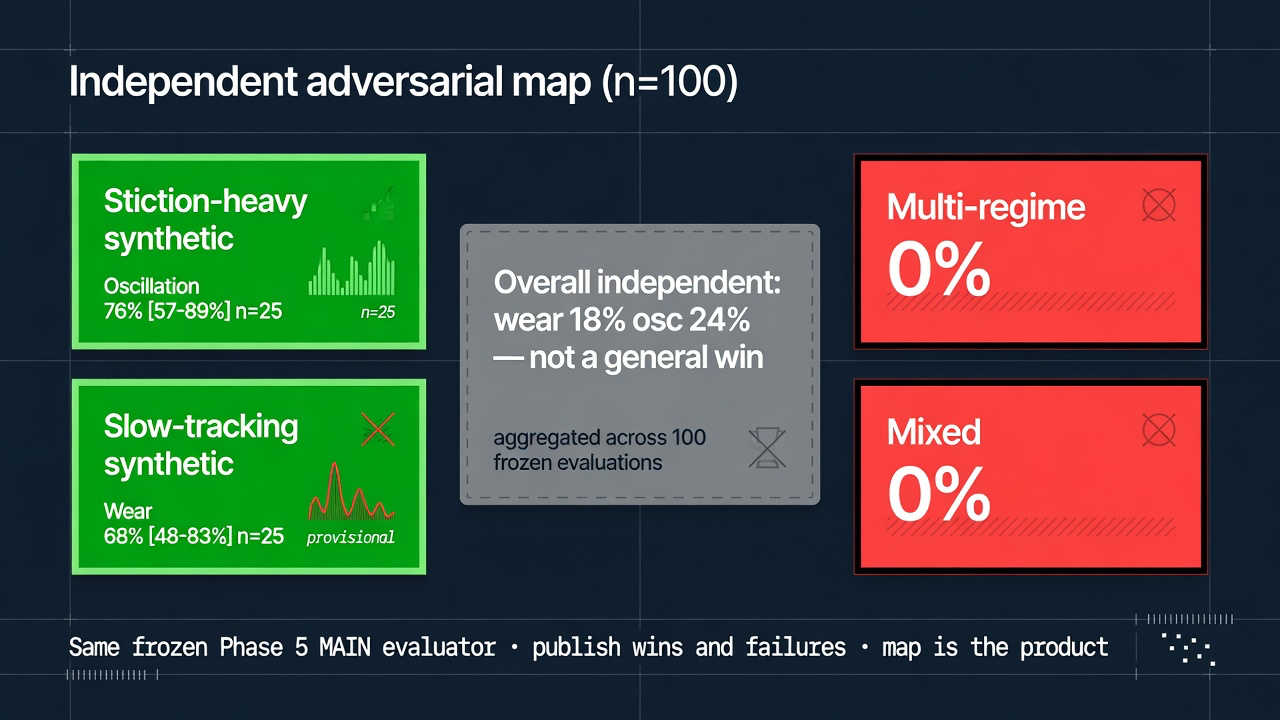
| Stiction-heavy independent synthetic | Reduces oscillation | 76% [57–89%] Wilson CI · n=25 |
| Slow-tracking independent synthetic | Reduces wear proxy (provisional) | 68% [48–83%] · n=25 · CI near 50% |
| Synthetic oscillation-dominant packs | Mid-band osc / spectral calm | ~+35% osc31 · ~−70% sweet-band spectral (phase6.2-class locked packs) |
| Synthetic SCADA Phase 5 batteries | Multi-metric shaping (regime-bounded) | Frozen Phase 5 MAIN · labeled synthetic |
| Peak compression packs | Peaks toward declared normal | ~38% mean · 49/52 wins (excellence hunt) |
| True cmd+meas robot fleet (ABB / UR / Franka) | Wear/travel vs best EMA (continuous) | 298/298 wear · 0 losses · osc/rate surface-labeled · detail |
| KUKA LWR4+ joint torque (public) | Wear + osc vs EMA-proxy demand | 21/21 partial · proxy caveat · not true cmd |
How buyers estimate value (no invented $)
Three cost classes that flow from verified metrics — not vendor plant ROI calculators:
- Actuator motion class (mechanical) — Mid-band ring and peak chase correlate with extra travel and chatter. On green pathologies, lower osc / wear proxies are the Workbench signal. You convert travel/tickets into MTBF or parts $ after a shadow run.
- Pre-model hygiene (PdM / industrial AI) — Calmer mid-band inputs can reduce junk features into models. We do not claim “3× faster training” or GPU $ — log train time on a fixed recipe yourself. See also PdM pipelines.
- Not residual FA man-hours — GSRF is not a fixed false-alarm residual detector (EMA residual recall wins that locked match). Do not budget “hours saved on ghost residual alarms” from our Evidence.
Red lights (actuators & plants)
- Overall independent industrial synthetic — wear ~18% [12–27%], osc ~24% [17–33%], n=100; multi-regime & mixed strata 0% at 50% bar
- Real plant DAMADICS multi-day — composite mostly loss; wear ~1/75 — not a plant wear championship
- Clean tracking / integrating — do not force GSRF as EMA replacement for pure track
- Multi-minute delayed command loops — published red light for delay misuse
- Fixed-FA residual detection — not the product; locked probes favor EMA residual
- Unscoped “~95% adversarial wear” — generator-family only, not independent law
Where it sits in the stack
Proprioception / force / OP–PV (positive or offset)
→ GSRF Practical (per channel; mid-band damp + peak pull when domain fits)
→ features / model · display · shadow before any command influence
Joint controller · drive filters · Kalman fusion · residual FA → stay separate
Scale & pricing anchors (for OEMs and fleets)
A 50-joint platform is not a hobby-tier conversation. Indicative packaging on Pricing (final terms by agreement):
| Tier | Scale (indicative) | Price anchor |
|---|---|---|
| Eval | 1–few channels, public snippet / bench | Free (no production rights) |
| Pro | Defined deployment · order of ≤10 production channels | ~$5k / year |
| Enterprise | Multi-channel site / robot cell / multi-deployment | ~$50k+ / year |
| OEM embed | Library inside a product · unlimited runtime instances under license scope | Contact (often ≥ Enterprise) |
Channel counts are negotiation anchors, not hard SKU meters. Quantum is a separate ladder.
Pathology-class pilot (pre-declare success)
- Pick N valves or (when available) joint channels with a named pathology — mid-band hunt, stiction-class ring, slow-track wear class — not “all joints.”
- Export OP/PV or demand/measured, positive or offset; freeze a normal for
x*(per channel if fleet). - Run Try or gsrf-bench vs EMA: osc · wear proxy · MAD.
- Write success bars before the run. Measure your own cost class (travel, tickets, train thrash) — we do not invent plant $.
- Shadow only; kill switch = bypass. Production after safety cage.
Verdict
Commercial story that holds: dozens of actuators → noisy proprioception compounds → deterministic pre-stage for mid-band ring and peaks — not a controller. Claim ladder: valve/SCADA + independent map + true command+measured robot wear holds (ABB/UR/Franka continuous; osc/rate surface-labeled). Multi-joint density is a real risk story; public evidence is pre-stage metrics — not a mission-abort or plant-wear dollar claim. Domain map, not miracle ROI.
Sources: True cmd robot fleet · Independent map · Industrial Evidence · Phase 5 batteries note · When GSRF lost · Citations · Contact info@boonmind.io